
When it comes to improving a car’s performance on track, tires and suspension upgrades often get the most attention. But wheel alignment can make a significant difference in how a car handles, even without changing any major components.
Small adjustments can influence steering response, cornering grip, stability, and tire wear.
Factory alignments are designed to balance performance, comfort, and tire longevity. For a car that regularly sees track use, those priorities can change.
As I gained experience tracking my Scion FR-S, I gradually moved toward a more aggressive alignment. Here’s an introduction to the main adjustments, what they do, and how I applied them to my own car.
Camber: Keeping the Tire Planted
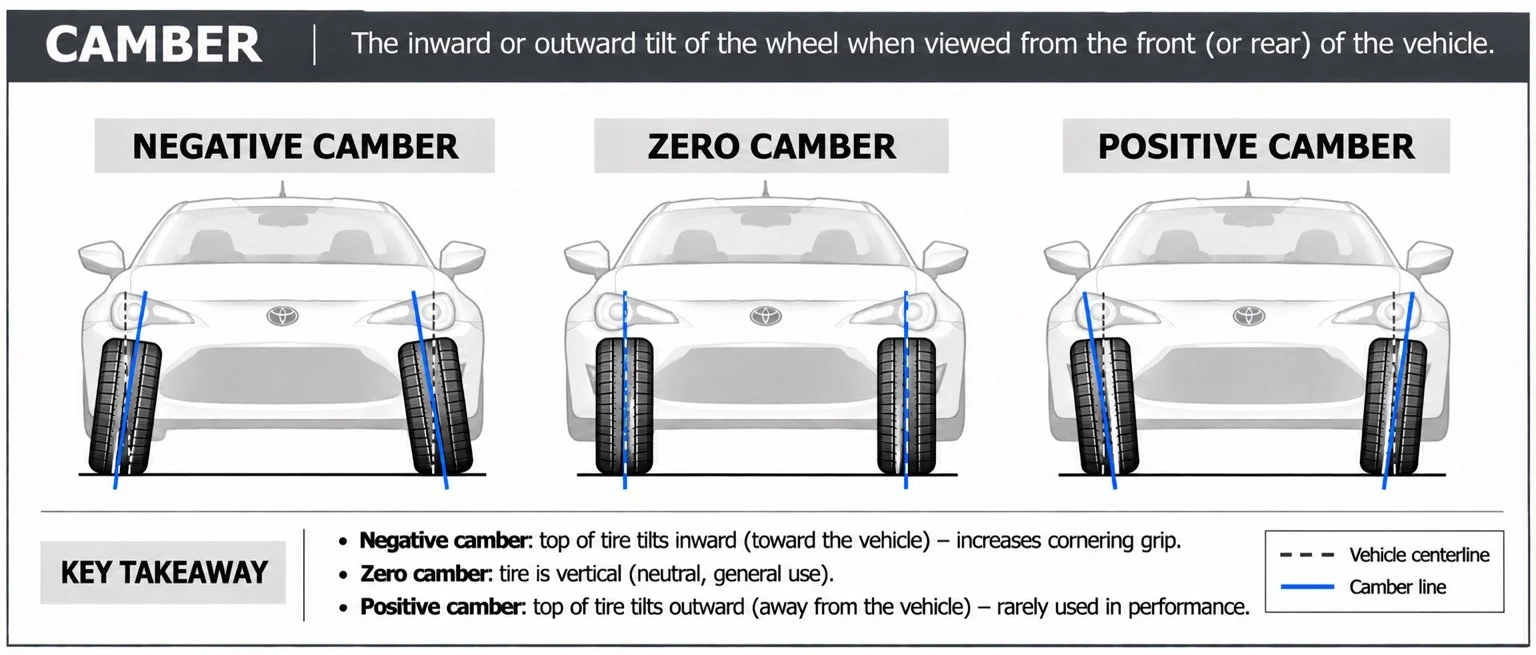
Negative, zero, and positive camber, viewed from the front of the car.
Camber is the angle of the wheel when viewed from the front or rear. Negative camber means the top of the wheel tilts inward, while positive camber means it tilts outward.
During cornering, body roll, suspension movement, and tire deformation affect how the tire contacts the road. Negative camber helps keep the outside tire more favorably oriented under load, potentially improving cornering grip.
However, excessive negative camber can compromise braking performance and contribute to uneven tire wear. More isn’t always better.
My Experience with Camber
When I first started tracking the FR-S, I retained the factory shocks and springs and installed aftermarket camber bolts. These provided an inexpensive way to gain additional front negative camber, although adjustment was limited to approximately −1.5 degrees.
I ran this setup for about a year before wanting more front-end grip.
I eventually installed adjustable front camber plates and rear lower control arms, allowing a much wider adjustment range.
I took the car to West End Alignment in Orange County, CA, a shop well known in the Southern California motorsports community for track-focused alignments.
We settled on the following setup, still using the factory shocks and springs:
| Parameter | Setting |
|---|---|
| Front camber | −3.0° |
| Rear camber | −2.5° |
| Front toe | 0 |
| Rear toe | 3/32” toe-in |
The difference was immediately noticeable. Turn-in was sharper, front-end feedback improved, and there was noticeably more grip through corners.
By then, the FR-S was no longer my daily driver, so I was comfortable accepting the potential tire-wear compromises.
Toe: Response Versus Stability
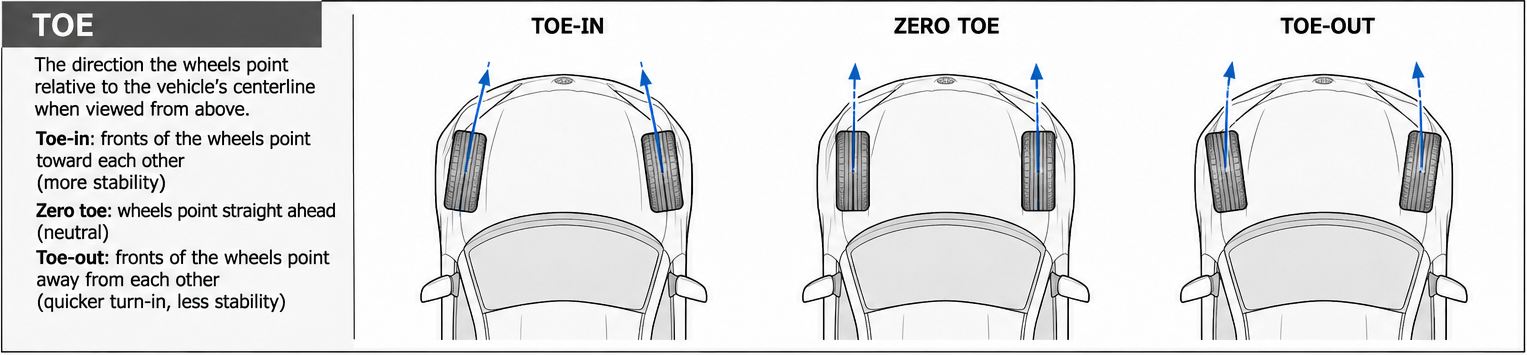
Toe-in, zero toe, and toe-out, viewed from above.
Toe describes the direction the wheels point when viewed from above.
Toe-in: The fronts of the wheels point toward each other.
Toe-out: The fronts point away from each other.
Zero toe: The wheels point straight ahead.
At the front axle, toe-out can improve initial turn-in response but may make the car feel nervous or less stable. Toe-in generally favors straight-line stability.
At the rear, toe-in helps promote predictable handling, while toe-out can encourage rotation at the expense of stability.
Toe also has a significant impact on tire wear. Because the tires are pointed slightly away from their direction of travel, they continuously scrub against the road.
For my FR-S, I chose zero front toe and a small amount of rear toe-in, balancing steering response with rear-end stability.
Caster: Steering Feel and Dynamic Camber

Positive and zero caster, showing the steering-axis angle from the side.
Caster is the angle of the steering axis when viewed from the side.
Positive caster means the steering axis tilts rearward toward the top of the vehicle. It contributes to straight-line stability and helps the steering return toward center.
Caster also affects camber as the wheels turn. Positive caster generally causes the outside front wheel to gain negative camber during steering, helping maintain a favorable tire orientation through corners.
Increasing caster can influence steering effort and feedback, although it isn’t always adjustable with factory suspension components.
Ride Height and Rake
Ride height isn’t technically an alignment angle, but it directly influences suspension geometry.
Lowering a car reduces its center of gravity, potentially improving handling. However, it also changes suspension angles and reduces available travel.
Too little suspension travel can cause the car to contact its bump stops more frequently, reducing grip and predictability.
Rake describes the car’s front-to-rear attitude, which can also influence suspension behavior.
When I installed RCE SS1 coilovers on the FR-S, I lowered the front approximately 1.25 inches and the rear 1.0 inch from the original measured ride heights.
This also gave me the ability to corner balance the car.
Corner Balancing: Understanding Cross Weight
Corner balancing involves measuring the load supported by each tire using four individual scales.
With adjustable coilovers, small changes to the spring perches redistribute load between the corners.
The goal isn’t necessarily to make all four corner weights equal. Instead, a common target is approximately 50% cross weight.
Cross weight is calculated using the combined weight of two diagonally opposite corners:
Cross Weight (%) = (Right Front + Left Rear) ÷ Total Weight × 100
At 50% cross weight, both diagonal pairs support equal portions of the vehicle’s total weight.
This provides a useful baseline for balancing left- and right-hand cornering behavior, although it doesn’t guarantee identical handling in both directions.
Importantly, corner balancing doesn’t change the car’s total weight or fundamental front-to-rear weight distribution. It changes how the load is shared among the four tires.
My FR-S Alignment and Corner Balance

My FR-S at West End Alignment after the corner balance and track alignment.
After installing the RCE SS1 coilovers, I returned to West End Alignment for another track alignment and corner balance.
Here were the results:
| Parameter | Setting |
|---|---|
| Front camber | −3.2° |
| Rear camber | −2.4° |
| Front toe | 0 |
| Rear toe | 3/32” toe-in |
| Cross weight | 50.01% |
| Front/rear distribution | 56.1% / 43.9% |
| Total weight | 2,869 lb with driver |
For the corner balance, I sat in the driver’s seat while the car was on the scales. I weighed approximately 148 pounds, and we used roughly half a tank of fuel to represent typical track conditions.
The result was 50.01% cross weight, essentially an even diagonal distribution.
Notice that the car still carried 56.1% of its weight over the front axle. A 50% cross weight doesn’t mean a 50/50 front-to-rear weight distribution.
These settings established a consistent baseline for my suspension setup.
Finding the Right Balance
One thing I’ve learned from tracking cars is that suspension setup isn’t about finding one perfect number.
Camber, toe, caster, ride height, and corner balance all influence handling, and changing one can affect another.
For a street car, factory alignment specifications may be entirely appropriate. For a track-focused car, more aggressive settings can offer improvements, provided the tradeoffs are understood.
Ultimately, the best alignment isn’t necessarily the most aggressive one.
It’s the one that works for the car, its tires, the driver, and how it’s actually being used.