
To possibly replace the FR-S, I was looking for something that could, at the very least, provide everything the FR-S had given me on track, but also accommodate my new daily daddy duties. Four doors, room for the family, and a car seat that could comfortably fit in the back.
Enter the Toyota GR Corolla.
The GRC had been getting rave reviews online, and it offered quite a few firsts for me personally:
My first 3-cylinder engine
My first hatchback
My first AWD car
A practical family car that could still deliver on track? At least on paper, it seemed to check all the boxes.
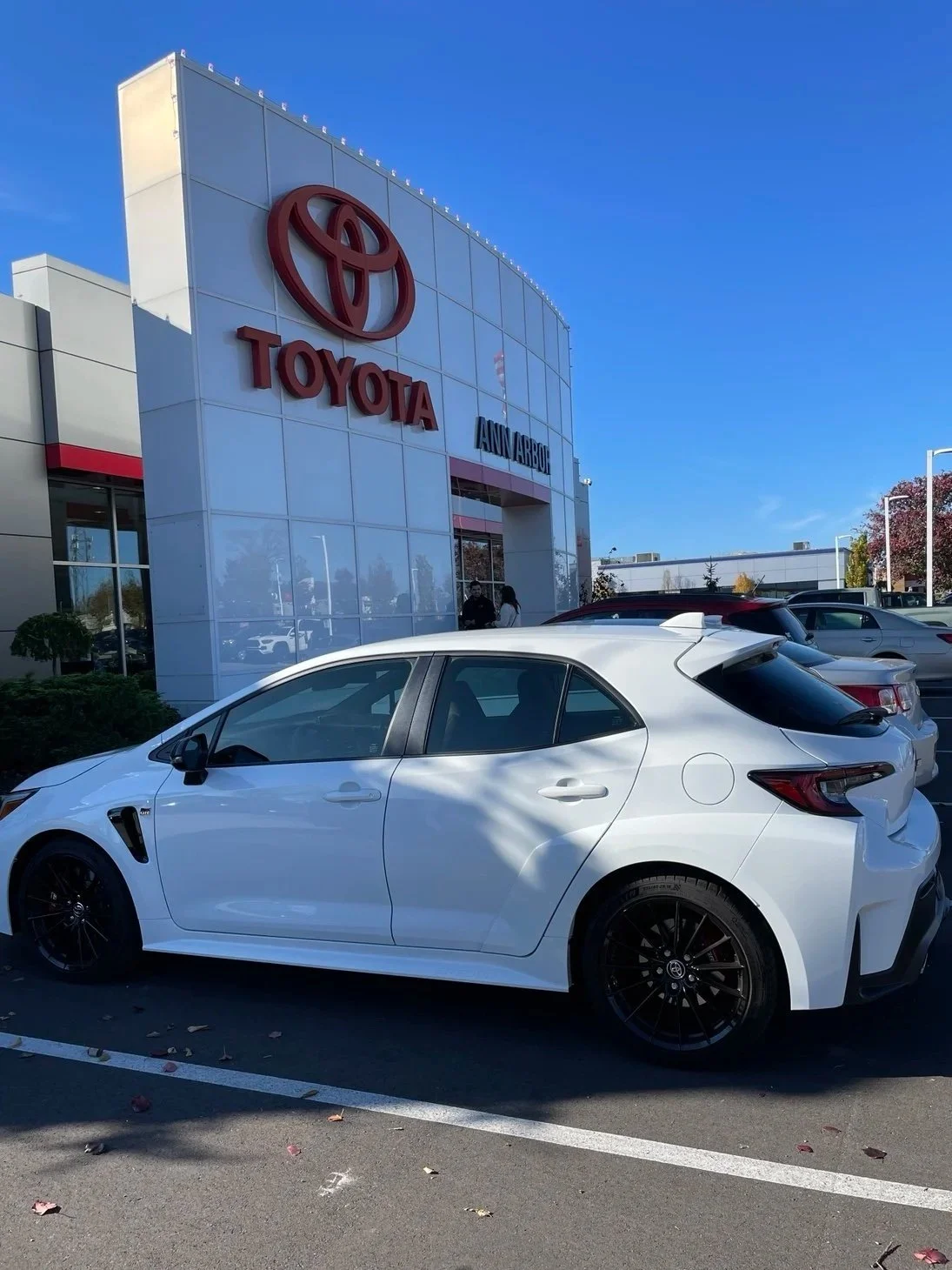
Why the GR Corolla?
For starters, there was the obvious connection to Toyota, my employer at the time. I was fortunate enough to be able to order a brand-new GRC directly through work, built to my specifications.
Then there was the turbocharged engine. Having owned and modified a Supra in the past, the idea of getting back into a turbocharged platform was exciting. I had fond memories of how much potential the 2JZ had, and I was hopeful that Toyota's little 1.6L three-cylinder might offer some of that same tuning potential.
And finally, there was GridLife.
After competing in GridLife's first event out west at Streets of Willow, I had been thinking about getting more involved in their events. Looking through the ClubTR rulebook, I thought the GR Corolla could potentially be a competitive platform for the class.
A Potential Club-TR Contender?
ClubTR was intended for relatively lightly modified, street-drivable track cars. The rules allowed naturally aspirated engines up to 2.5L, or factory turbocharged engines in the 1.6L category, while limiting modifications to keep the competition reasonably balanced.
This was where the GR Corolla really caught my attention.
Toyota had managed to squeeze 300 horsepower out of a tiny 1.6L three-cylinder engine. That's roughly 185 horsepower per liter, which was pretty impressive for a factory engine.
With the class restricting engine displacement and limiting turbocharger modifications, I thought the GRC's high specific output could be a real advantage. It already made considerable power without needing extensive engine modifications.
Then there was the GR-FOUR all-wheel-drive system. Having AWD, along with front and rear Torsen limited-slip differentials, seemed like it could offer a traction advantage, particularly when putting power down on corner exit.
Of course, there were tradeoffs. At roughly 3,260 pounds, the GRC was considerably heavier than the lightweight RWD cars commonly found in ClubTR. And with everyone competing on the same Falken RT660 tire, limited to a 255 width, that extra weight wasn't going to disappear.
Still, I thought the combination of power, AWD, and a relatively modest level of permitted modifications could make the GRC an interesting contender.
At least, that was my theory. I was looking forward to putting it to the test.
The Car
I went with a 2024 Toyota GR Corolla Core in Ice Cap White, equipped with the Performance Package.
I specifically wanted the Performance Package for its front and rear Torsen limited-slip differentials. With plans to take the car to the track, this was an option I wasn't willing to skip.
Finally Home
After four months of waiting since placing my order through work, it was finally time to pick it up!
Seeing the two cars together was a fitting moment. The FR-S had been a big part of my journey as a driver, and now I was hoping the GRC would pick up where it left off.
I had high expectations for the new car. Not just as something fun to drive every day, but as a car that could continue pushing me to improve on track.
Now it was time to see what it could do.
Come back for my review and first impressions of the GRC.
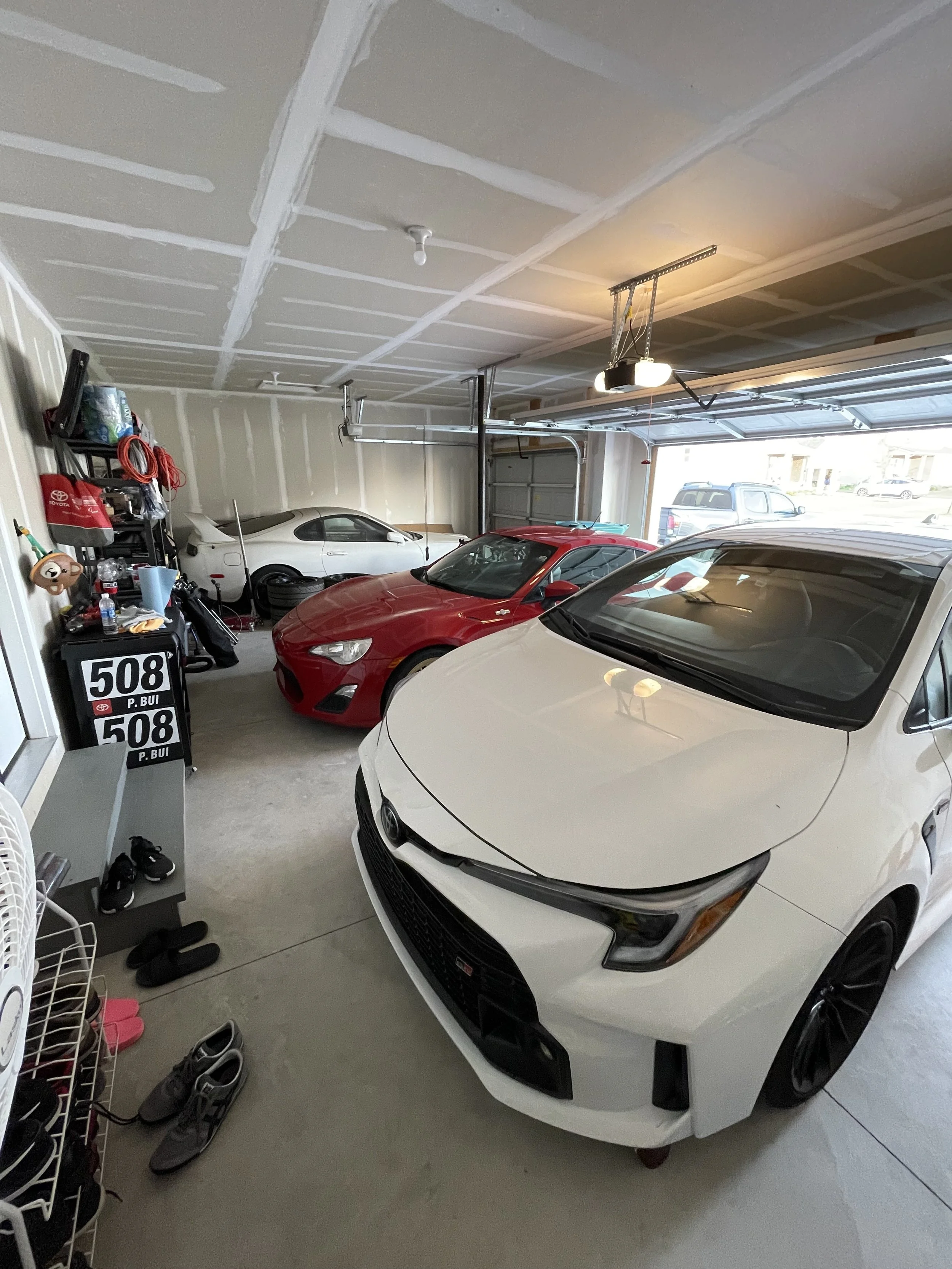
April 2024. The GR Corolla arrives home, joining its Toyota siblings in the garage
SPECIFICATIONS TABLE
Engine & Performance
| Specification | Details |
|---|---|
| Engine | G16E-GTS |
| Configuration | Turbocharged inline 3-cylinder |
| Displacement | 1,618 cc (1.6L) |
| Valvetrain | DOHC, 12 valves |
| Bore × stroke | 87.5 × 89.7 mm |
| Compression ratio | 10.5:1 |
| Fuel injection | Toyota D-4S, direct + port injection |
| Turbocharger | Single-scroll, ball-bearing |
| Maximum boost | 25.2 psi |
| Horsepower | 300 hp @ 6,500 rpm |
| Torque | 273 lb-ft @ 3,000–5,500 rpm |
Transmission & Drivetrain
| Specification | Details |
|---|---|
| Transmission | 6-speed manual with iMT |
| Drivetrain | GR-FOUR all-wheel drive |
| Center coupling | Electronically controlled multi-plate clutch |
| AWD modes | 60:40 / 30:70 / 50:50 nominal front torque distribution |
| Front differential | Torsen limited-slip |
| Rear differential | Torsen limited-slip |
Chassis, Suspension & Brakes
| Specification | Details |
|---|---|
| Platform | Toyota TNGA-C, GR-reinforced |
| Front suspension | MacPherson strut |
| Rear suspension | Double-wishbone-type multilink |
| Front brakes | 14.0-inch ventilated, slotted rotors; 4-piston fixed calipers |
| Rear brakes | 11.7-inch ventilated rotors; 2-piston fixed calipers |
| Wheels | 18-inch cast aluminum |
| Factory tires | Michelin Pilot Sport 4, 235/40R18 |
Dimensions & Weight
| Specification | Details |
|---|---|
| Wheelbase | 103.9 inches |
| Overall length | 173.6 inches |
| Overall width | 72.8 inches |
| Curb weight | Approximately 3,260 lb |
| Seating | 5 passengers |
| Body style | 5-door hatchback |